Bond Lodgement Excel Template Australia (2026)
3
Free download
Budget, levy contribution, dashboard and instruction sheets for Australian body corporate committees and strata managers planning 2026 costs.
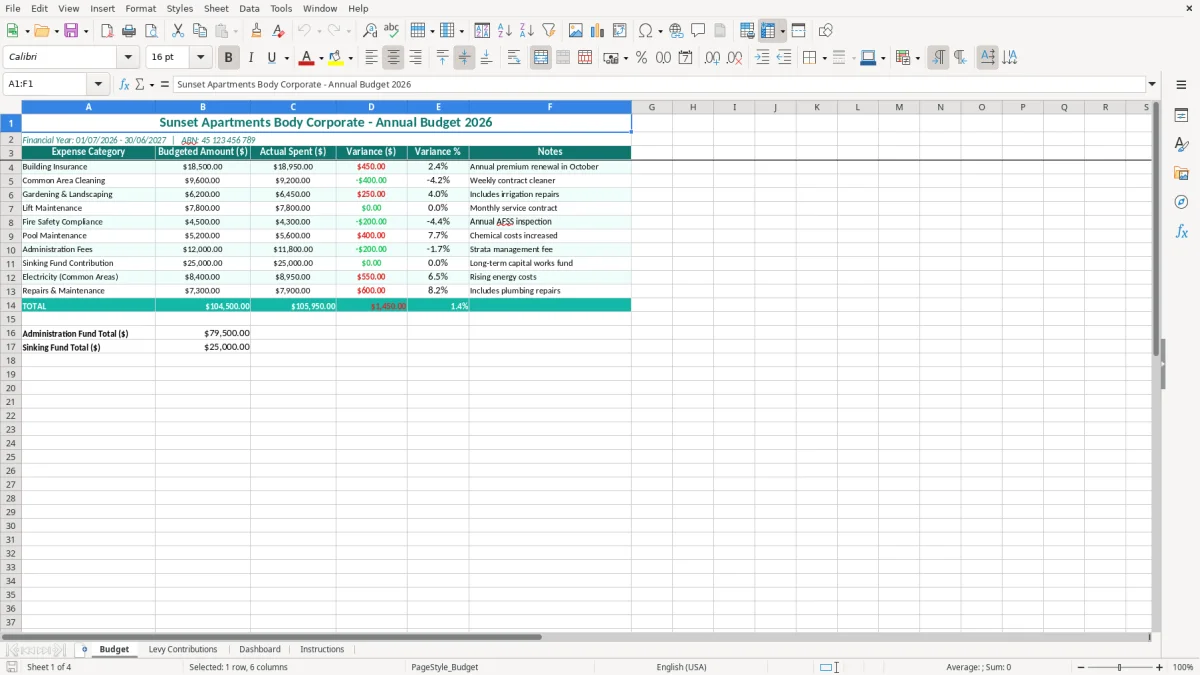
A body corporate budget Excel spreadsheet is used to plan shared property costs, compare budgeted amounts with actual spending and monitor levy funding. This template includes a Budget sheet, Levy Contributions sheet, Dashboard and Instructions sheet for the 2026-27 financial year.
It is set up for an Australian apartment or townhouse complex, with fields for building insurance, cleaning, gardening, lift maintenance, fire safety, pool maintenance, administration and sinking fund contributions. Image 1 shows the main six-column budget layout, including variance dollars, variance percentage and notes.
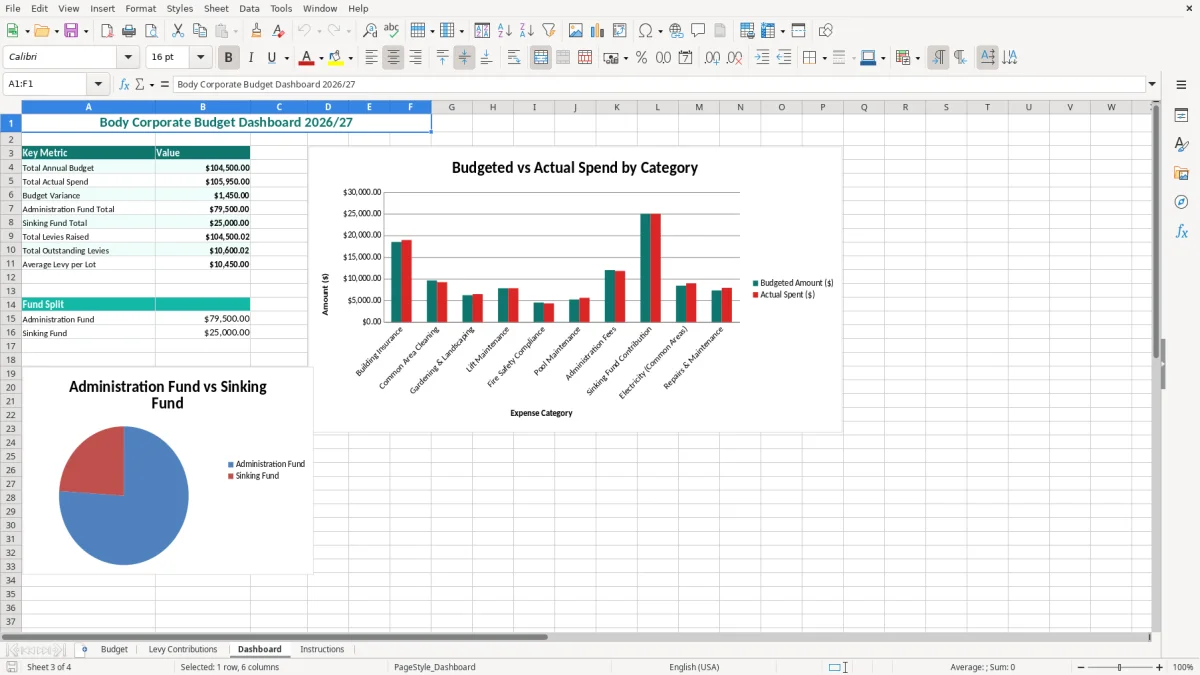
The colour-coded workbook gives your committee a practical starting point before an annual general meeting. You can replace the sample figures with quotes, contracts and prior-year invoices, then use the Dashboard in image 3 to explain the position to owners.
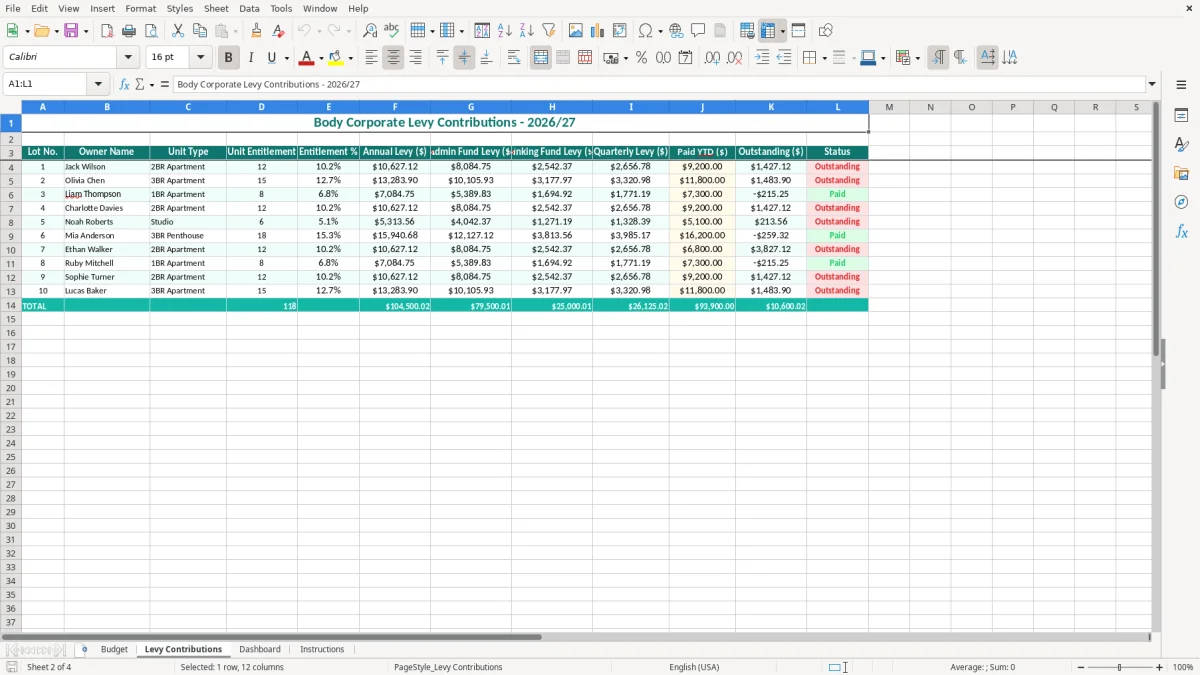
A volunteer committee member often opens this spreadsheet in the weeks before the annual general meeting, when the next financial year's levies and planned works need to be discussed. A strata manager or bookkeeper can use it earlier to collect insurance renewals, contractor quotes and expected statutory inspection costs into one working file.
The Budget sheet is particularly useful for a small scheme that does not yet need a full budgeting module in property software. Image 1 shows the six columns that matter in a committee conversation: the expense category, budgeted amount, actual spent, dollar variance, percentage variance and a notes field.
Imagine 24 apartments with an annual budget of $92,000. Building insurance is budgeted at $18,500, common-area cleaning at $9,600 and lift maintenance at $7,800. If the insurance renewal comes in at $18,950, the $450 movement is immediately visible rather than being buried in a bank transaction list.
For a committee with four members, the spreadsheet makes it easier to challenge a $6,450 gardening result against a $6,200 budget and record that irrigation repairs caused the extra $250. That explanation is useful when owners ask why the budget was not followed exactly.
A bookkeeper in a small Pty Ltd strata management business might update actuals after the monthly bank reconciliation, while a volunteer treasurer may only update them before each quarterly meeting. The Dashboard in image 3 then turns the detailed categories into a quick presentation view, and the Levy Contributions sheet helps connect the approved total to owner funding.
This is not just an AGM document. It can be used after a storm, a lift breakdown or an insurance renewal to show the committee which existing allocation is affected and whether the sinking fund needs a separate decision.
Body corporate and strata schemes are governed by state and territory legislation, not one national body corporate budget rule. For example, Queensland schemes operate under the Body Corporate and Community Management Act 1997, while New South Wales strata schemes operate under the Strata Schemes Management Act 2015. The workbook is a budgeting tool, not a substitute for the notice, voting and record requirements applying to your scheme.
That distinction matters because an ordinary administrative fund budget is not the same as a sinking fund or capital works plan. Keep the approved budget, levy motion, meeting minutes and supporting quotes together; a spreadsheet cannot by itself authorise expenditure or alter a contribution schedule.
Use the Budget sheet to distinguish day-to-day costs such as cleaning, gardening and administration from longer-term building works. In the supplied example, the sinking fund contribution is $2,500. If the scheme has 20 equal lots, that line alone represents $125 per lot for the year, before administrative levies and any different entitlement basis are applied.
Insurance, fire safety and lift obligations need particular attention. An annual insurance premium of $18,500 should be supported by the policy schedule, while an AFSS inspection or other compliance cost should be supported by the relevant contractor document and the applicable state requirement.
Retain invoices, bank statements, levy notices, reconciliations and committee approvals in an orderly record system. The ATO generally requires business records to be kept for 5 years, although state strata legislation, scheme records and legal claims can require longer retention.
Do not assume every body corporate levy is treated as ordinary GST-bearing income or expenditure. GST treatment depends on the entity, registration position and transaction; review supplier tax invoices and the scheme's BAS treatment where GST applies. Image 2 shows the Levy Contributions sheet, which should be checked against the legally approved lot entitlements rather than used to invent a new levy formula.
The most common practical problem is entering a supplier invoice when it arrives and then entering the same amount again when it is paid. A $1,200 cleaning invoice can become $2,400 of apparent actual spending, producing a false 25% or 100% variance depending on the total budget. Decide whether the workbook records invoices or payments and use one method consistently; for a small scheme, payment-based actuals are usually easier to reconcile to the bank.
The opposite error is also costly. If a $18,950 insurance renewal is paid in October but the full annual cost is not included in the budget, the committee may think it has an unexplained overspend when the real issue was an incomplete starting figure.
Small line items are regularly missed: pool chemicals, emergency call-outs, irrigation repairs, fire inspection fees and lift repairs. A $250 repair is not large by itself, but ten unplanned items add $2,500 to a scheme with limited levy capacity. The Notes column is there to record whether an amount is a fixed contract, a quote, a prior-year actual or a contingency.
Insurance is another trap. A budget of $18,500 followed by a $20,350 renewal is an $1,850 shortfall, or 10% above budget. If that movement is not identified before levy notices are prepared, owners may face a late special levy discussion rather than a planned adjustment.
Committees sometimes use the levy contribution total to cover a capital project without checking the approved sinking fund plan or the scheme's voting requirements. A $30,000 roof repair cannot simply be hidden by increasing a routine cleaning line by $2,500. Keep the funding purpose clear, use image 2 to check lot contributions, and record the approval behind every material change.
Finally, never overwrite an approved budget with actuals. Save the approved version first, then update actual spending in a copy or controlled working file. That preserves the audit trail when an owner asks why the Dashboard figure changed after the AGM.
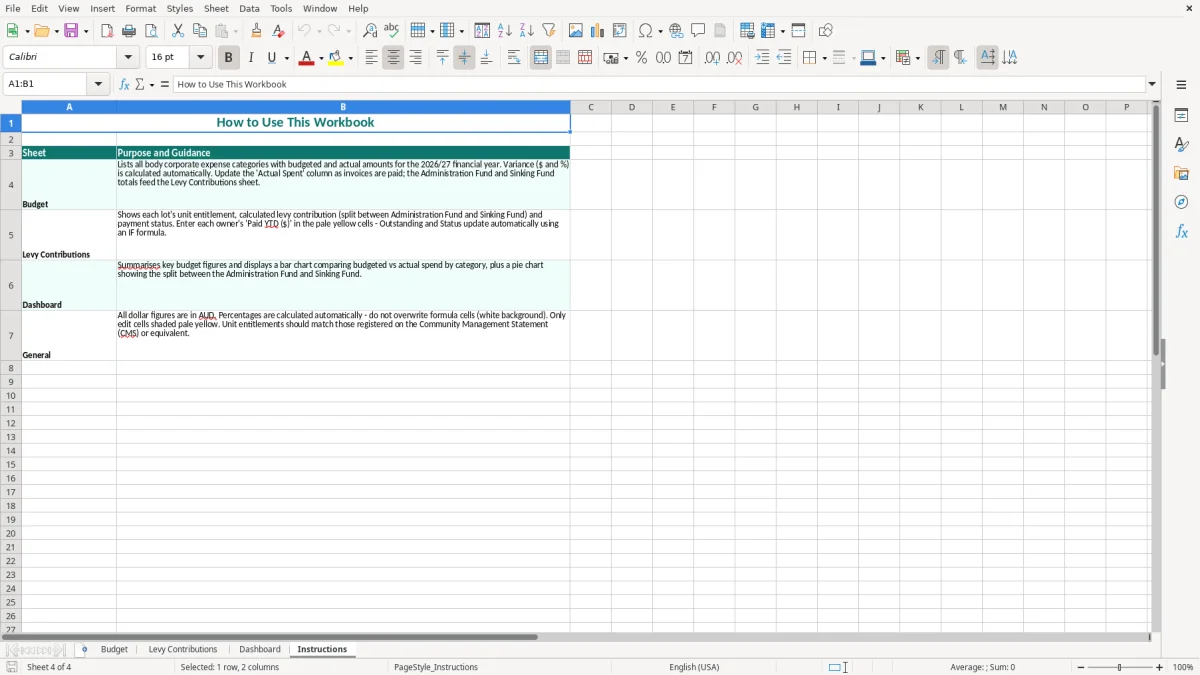
The easiest routine is to update the workbook immediately after the body corporate bank account is reconciled. Set aside 20 minutes on the first Friday of each month: match payments to invoices, enter actual amounts, review the variance columns and add a note for anything unusual.
Do not wait until the AGM. Twelve small reviews are more useful than one three-hour data-entry session, particularly when a $450 insurance movement or $250 gardening repair can still be acted on.
This template suits a modest scheme with a manageable number of expense categories and regular bank transactions. Move to strata software or an accounting platform such as Xero or MYOB when you are tracking many lots, multiple bank accounts, work orders, levy arrears, GST reporting and detailed owner statements.
A useful trigger is repeated manual work: if four committee members spend 2 hours each every month fixing duplicate entries, that is 96 hours a year. At a bookkeeping cost of $60 an hour, the time alone is worth $5,760, before considering missed levies or reporting errors. Keep Excel for scenario planning if you move systems, but make one system the source of truth.
That same switch also makes it easier to keep a levy arrears record aligned with the source of truth.