Surf club roster Excel – Free Template (2026)
0
Free download
Track super due, super paid and shortfalls by employee, with a summary dashboard and instructions for Australian businesses.
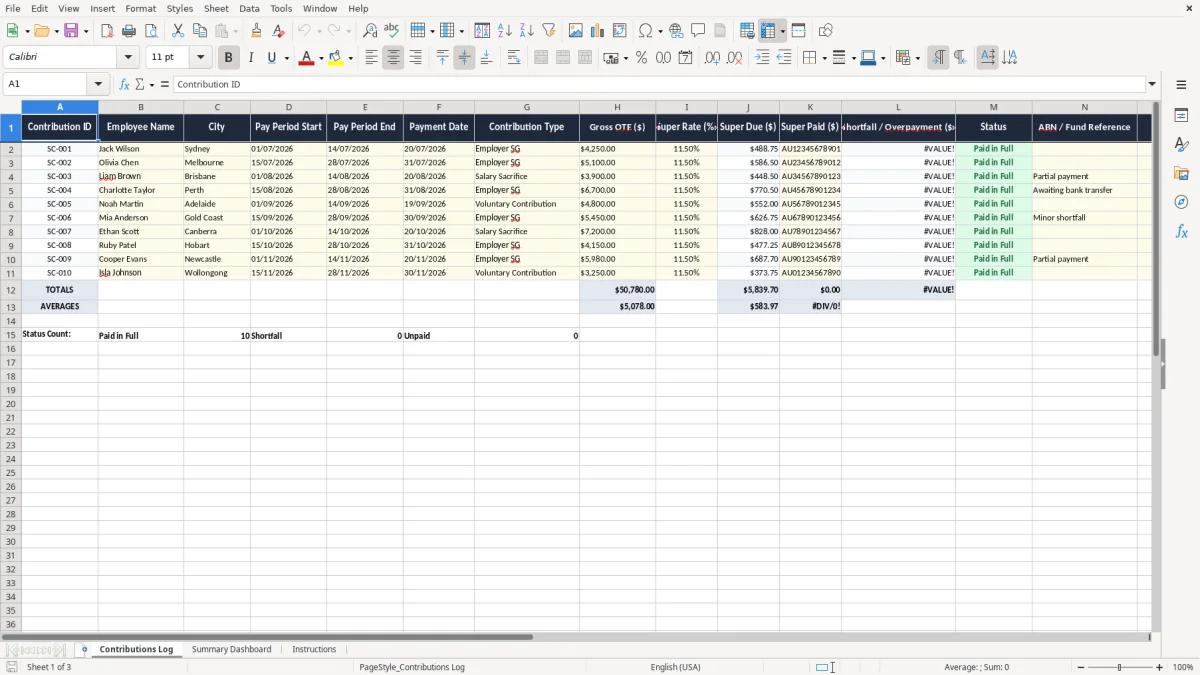
This superannuation contributions tracker Excel template helps you record superannuation due, paid and outstanding for each employee across each pay period. It includes a Contributions Log, a Summary Dashboard and Instructions sheet, so you can keep an eye on cash flow, shortfalls and payment timing in one place.
Use it when you want a simple check against your pay run, especially if you are paying a team manually or reconciling super after each fortnight. The log captures employee name, city, pay period dates, payment date, contribution type, gross OTE, super rate, super due, super paid, status and notes.
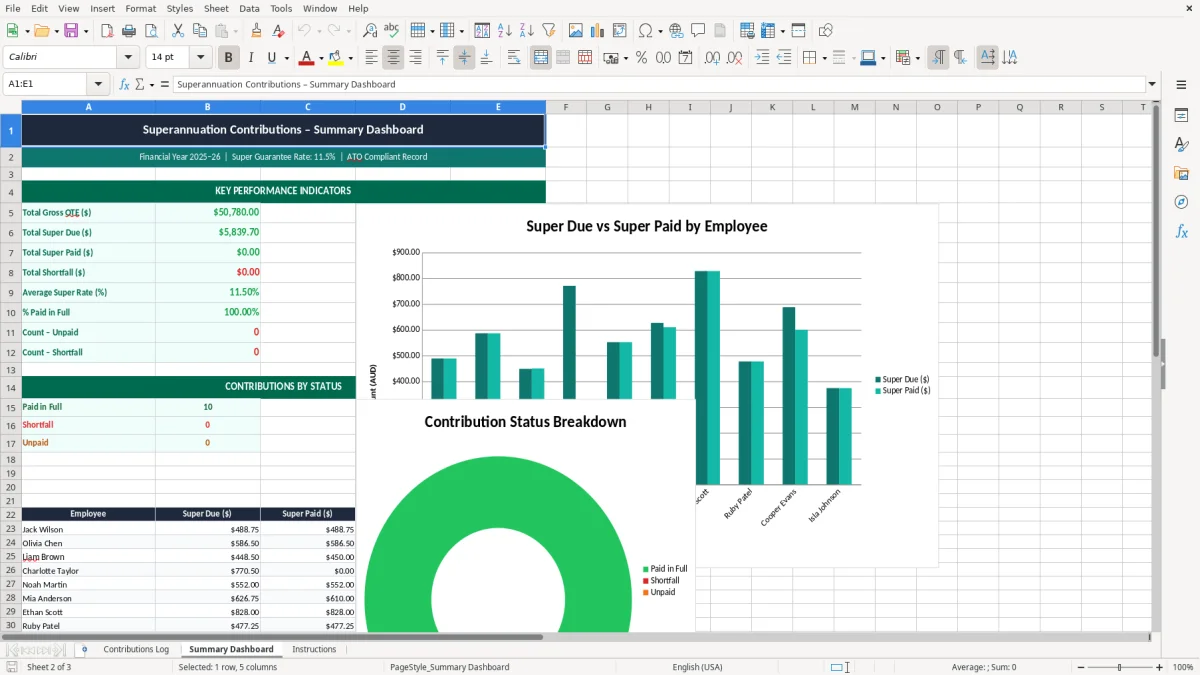
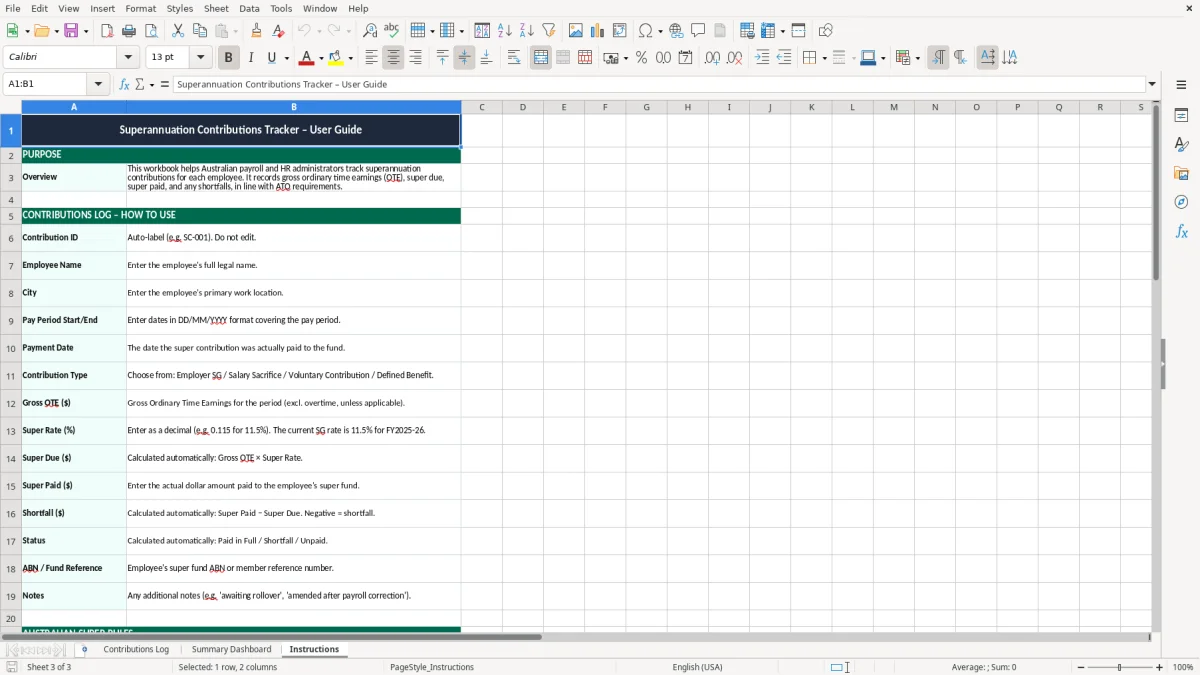
The dashboard gives you a quick snapshot of what is due and what has already been paid, while the Instructions sheet helps you set it up without mucking about. It is built for Australian small business bookkeeping, where the big headache is usually not the calculation — it is making sure nothing slips through before the quarterly deadline.
Sole traders with their first employee, bookkeepers in a Pty Ltd, and office managers at tradie businesses usually reach for a super tracker when the pay run is done and the numbers need checking. It is especially handy in the last week of the quarter, when you are trying to make sure every superannuation payment has been sent to a complying fund before the deadline.
Take a chippy with 4 employees on ordinary time earnings of $1,800, $2,100, $2,400 and $3,000 a fortnight. At 11.5%, the weekly super works out to $207.00, $241.50, $276.00 and $345.00 respectively, so one missed payment shows up fast in the log.
A sole trader with a part-time admin assistant can use the sheet to check the employer amount before paying the fund. A small wholesale business with 12 staff can use it to match the payroll journal to actual bank payments, then tick off each row once the contribution clears.
For small payrolls, Excel is often the quickest way to keep a clean audit trail without jumping straight into payroll software. You can sort by employee, filter by status, and line up the pay period dates against the payment date, which is enough to catch most mistakes before they become a super headache.
The Summary Dashboard is useful when you want the high-level view: total super due, total paid and the amount still outstanding. That is the kind of snapshot a bookkeeper wants before the BAS prep, or a business owner wants after a $24,000 payroll fortnight.
Employers must pay the superannuation guarantee at 11.5% in 2026, and the payment generally has to reach the employee’s fund by the quarterly due date, not just leave your bank account. For most small businesses, that means keeping your internal tracker aligned to the quarter ending 31 March, 30 June, 30 September and 31 December, then checking the actual payment dates against the fund receipts.
The ATO expects you to keep records for 5 years, and that includes payroll records that show how the amount was worked out. If an employee’s ordinary time earnings are $2,800 and you pay super at 11.5%, the contribution should be $322.00; if you only paid $300.00, the $22.00 shortfall needs to be visible straight away.
Super sits alongside PAYG withholding and STP reporting, so your payroll records need to tie back to what is reported and paid. The tracker does not replace your BAS or payroll system, but it does give you a clean working paper when you are checking figures before lodgement or payment.
The ABN / Fund Reference column is there because fund details matter when you are matching payments, especially if you are paying multiple super funds. If you pay 8 employees across 3 funds, a clear reference column saves you from chasing which transfer belongs to which employee at quarter end.
Fair Work also sits in the background because payroll compliance is not just about the amount of super, it is about paying people correctly and on time. A payroll that is $500 short on super across 6 employees can turn into a costly fix once you add admin time, follow-up calls and possible penalties.
The most common problem is using the wrong earnings base, especially when overtime, allowances or bonuses are mixed into the pay. If you calculate super on the wrong figure and miss $18.40 per employee over 12 employees, that is $220.80 out the door for a single pay cycle, and it is usually not the only error.
Another common issue is treating the payment date as the due date. If the money lands in the fund after the quarterly cut-off, the employer can still end up with a super guarantee charge, even if the transfer was started on time.
One missed super payment is rarely just the unpaid amount. You are also dealing with admin time to trace the transfer, reconcile the payroll record, and answer employee questions when someone notices their fund balance is light by $276.00 or $345.00.
Small errors in the Super Paid column can hide for months if the sheet is not reviewed regularly. A row that says $322.00 due and $320.00 paid looks close enough at a glance, but across 20 employees that kind of drift can leave you $40.00 short for the period and create messy end-of-quarter reconciliation.
Overpaying super is less painful than underpaying, but it still distorts your books and your profit and loss. If you pay an extra $150.00 to the wrong fund, you may spend an hour or more sorting the reversal instead of getting on with payroll, BAS prep or invoicing.
Those reversals become easier to trace when the payment and invoicing side is already clean, so the ABN invoice template keeps the paper trail aligned with the super entries.
The easiest way to keep this tracker alive is to link it to an existing task, like the pay run or the monthly reconciliation. If you run payroll every Thursday, make Friday morning the time to update the log, confirm the super amount and mark any unpaid rows.
For a team of 7 employees, this can be a 10-minute check if the file is kept tidy. For a business with 25 staff and multiple funds, Excel still works for a while, but once you are spending half a day on payroll admin each month, it is usually time to move to proper software like Xero or MYOB.
If you need automated STP, award interpretation, leave accruals and super clearing in one place, Excel has probably done its job. Keep the spreadsheet for spot checks and history, then let payroll software handle the heavy lifting once the business outgrows manual tracking.
That same move to payroll software also makes room for more detailed pay planning, including a salary sacrifice calculator for checking net pay and super contributions.