Property Depreciation Excel Template – Free (2026)
23
Free download
Owners corporation Excel template with a 10-year capital works forecast, levy contributions and dashboard for Australian strata schemes.
This owners corporation sinking fund Excel template helps strata committees and managers forecast common-property capital works, calculate annual funding needs and allocate levy contributions between lots. It includes a 10-year plan, contribution schedule, dashboard and instructions.
Enter each asset's useful life, renewal timing, estimated cost and inflation rate in the Sinking Fund Plan sheet. The template is set up with sample details for a Sydney NSW building, but you can replace the property information and project list with your scheme's figures.
Use the forecast before preparing the annual budget or presenting a special levy proposal. It gives owners a clearer view of why money needs to be collected now for a roof, lift, fire system or other major common-area work later.
A committee member usually opens this spreadsheet when the annual budget is being prepared, but it is just as useful when a building manager changes or owners start asking why the sinking fund balance is not keeping up with future works. A volunteer treasurer can use it to turn a list of ageing assets into a funding conversation with actual figures.
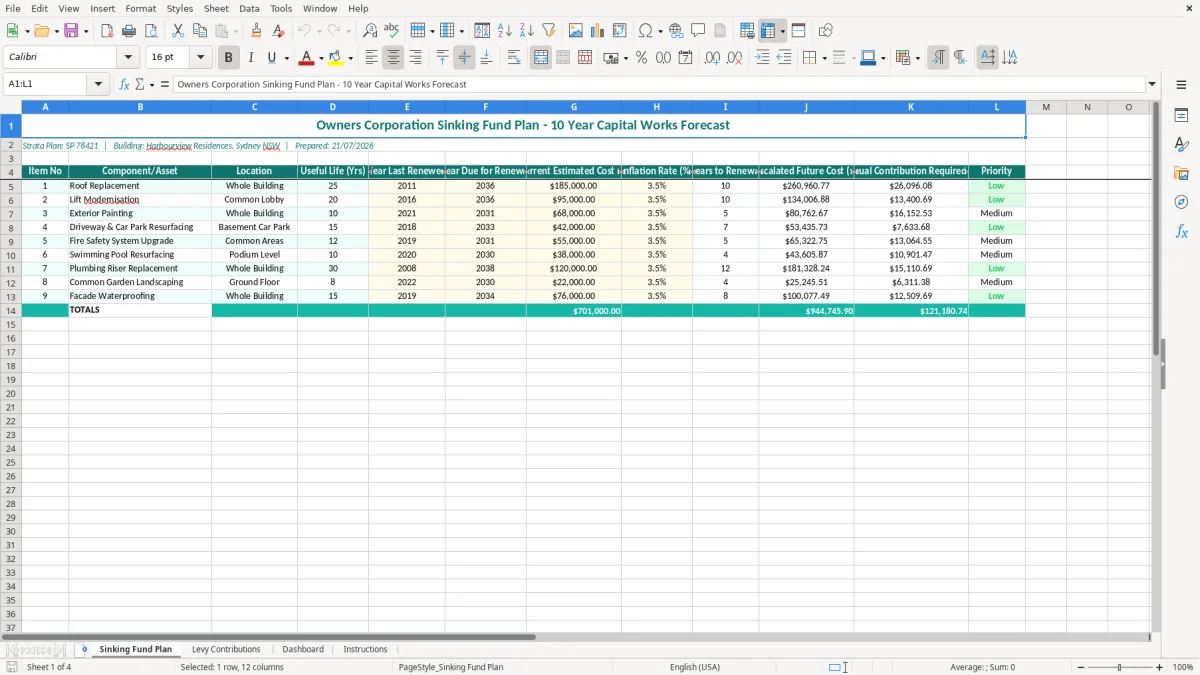
In image 1, the Sinking Fund Plan sheet lays out one project per row. The columns run from Item No and Component/Asset through Location, Useful Life (Yrs), Year Last Renewed and Year Due for Renewal, then into cost, inflation, timing, annual contribution and Priority. That structure suits a small apartment block where the committee knows the roof, lift, car park and fire equipment but has never put them on one timetable.
For example, a roof currently estimated at $185,000 with 10 years until renewal cannot be treated as a $185,000 problem at the end of that period. At 3.5% inflation, the future bill is roughly $258,000, or about $25,800 a year before allowing for the existing balance and investment income. The point is not to predict the quote perfectly; it is to expose the size and timing of the funding gap.
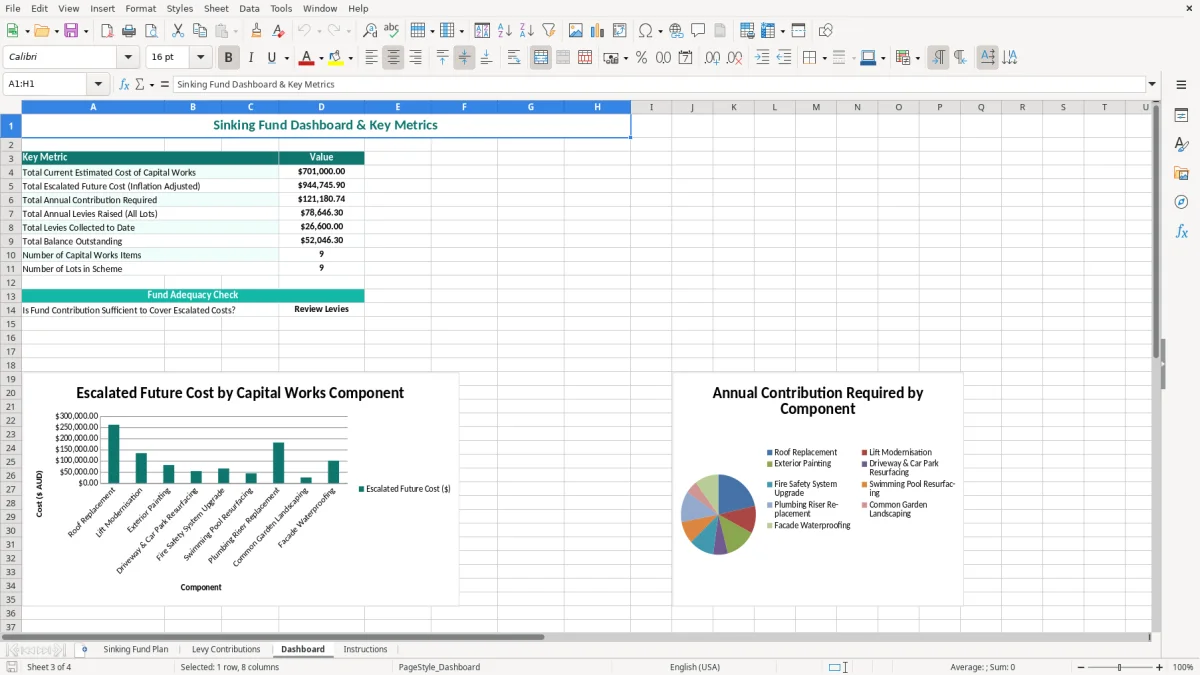
A strata manager can use the file to test the effect of changing a lift project from one year to another, while a volunteer treasurer can take the Dashboard to a meeting instead of explaining 12 separate calculations. An owners corporation with 40 lots might also use it when comparing a steady levy increase with a $1,000 special levy per lot.
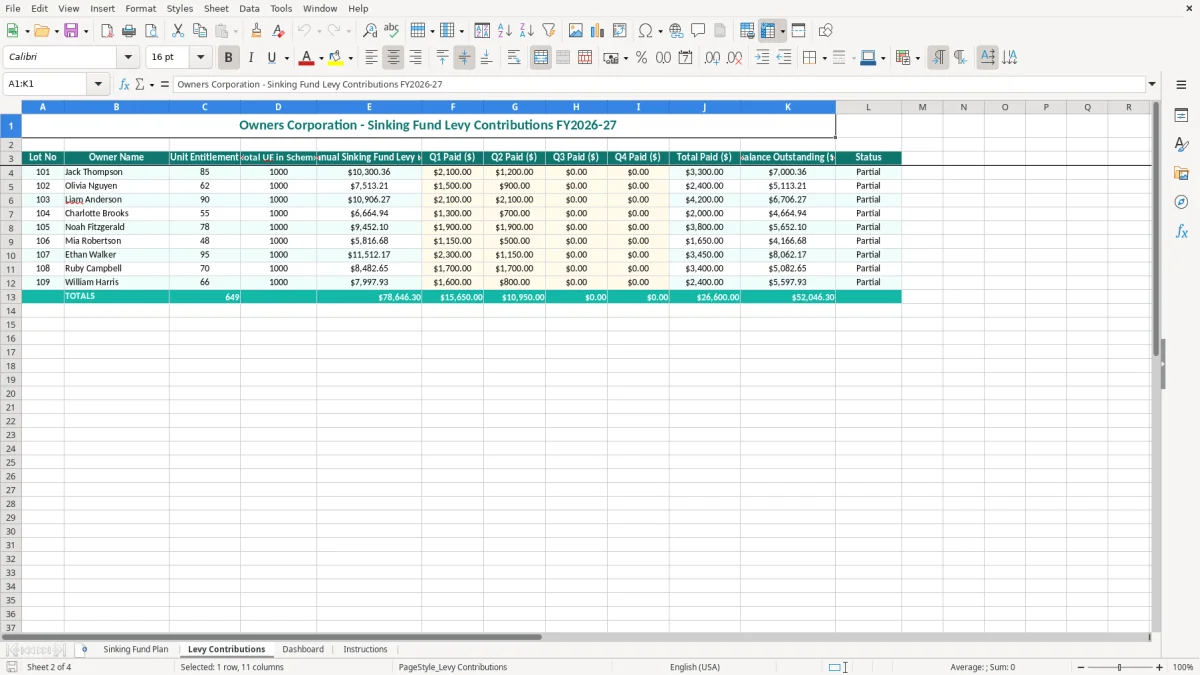
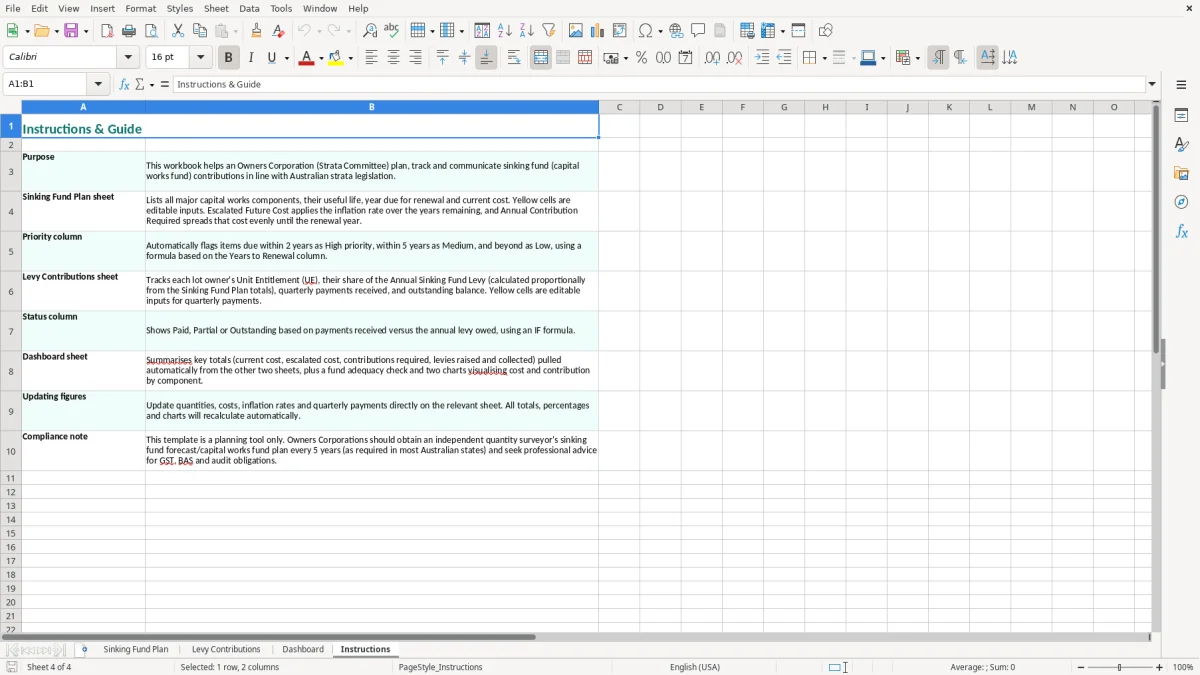
Image 2 shows the Levy Contributions sheet, where the plan can be connected to the lots and their funding shares. Image 3 provides the Dashboard view, and image 4 contains the Instructions sheet. Together, the four sheets make the workbook suitable for a quarterly committee check, an annual budget meeting or a handover to a new strata manager.
There is no single national strata statute that sets one sinking-fund formula for every Australian scheme. The relevant state or territory legislation, the scheme's registered unit entitlements and its by-laws determine how contributions are raised. This template is therefore a planning tool, not a replacement for the notice, budget or fund requirements applying to your scheme.
The sample property is Harbourview Residences in Sydney NSW, and the workbook is dated 21/07/2026. Under the Strata Schemes Management Act 2015 (NSW), a NSW owners corporation prepares a capital works fund plan covering at least 10 years and reviews it at least every five years. The plan should identify anticipated major expenditure and the contributions needed to meet it.
That 10-year horizon is why image 1 includes Useful Life, Year Last Renewed and Year Due for Renewal rather than only a current bank balance. If the committee estimates $120,000 of works in 10 years and assumes 3% annual inflation, the future estimate is about $161,270. Saving $12,000 a year will not fully fund that amount unless the starting balance and investment return cover the difference.
In many schemes, ordinary contributions are determined using unit entitlements, but the legal process and treatment of different funds must be checked against the state legislation and the plan's records. Do not simply divide a $60,000 annual target equally across 20 lots if the scheme's contribution schedule uses unequal entitlements.
For example, if one lot has a 75/1,000 unit entitlement, its share of a $60,000 contribution is $4,500 before any approved adjustments. Image 2 is useful for checking that the lot allocation adds back to the planned requirement. Keep the adopted plan, meeting minutes, quotations and levy notices with the workbook; Australian tax and strata record obligations commonly require financial records to be retained for at least 5 years, while your state legislation or scheme records may require longer retention.
Those retention rules also sit alongside payroll records, so the PAYG withholding spreadsheet is the natural companion for keeping deduction and payment details in order.
The most expensive problem I see is not a bad formula; it is an incomplete asset list. Committees remember the roof because it leaks, but forget balcony membranes, basement ventilation, pumps, access-control equipment or compliance upgrades until the contractor is standing on site. A spreadsheet that omits a $70,000 fire upgrade can make the fund look healthy while the real liability is growing.
Using the last invoice as today's cost is another trap. A $45,000 painting job from 8 years ago may be $65,000 now after labour, access equipment and materials have moved. If the committee budgets $5,000 a year for five years but the actual future bill is $65,000, it has created a $40,000 shortfall before considering the balance already held.
The opposite mistake is applying one inflation rate to everything. A 3.5% building-cost assumption may be reasonable for a broad forecast, but lift modernisation and specialist fire services can move differently from general construction. Use the rate as a transparent planning assumption, flag large projects for fresh quotes and record the reason for a major change in the meeting papers.
A common spreadsheet error is allocating the annual requirement equally when lot entitlements are unequal, then adding a second levy for the same project without reducing the original forecast. On a $100,000 plan, a 10% allocation mistake moves $10,000 to the wrong owners; in a 30-lot scheme that is more than $333 per lot on average.
Check the totals in image 2 against image 1 after every change. Also separate routine repairs from capital renewal: replacing a failed light fitting is not the same funding event as replacing an entire electrical system. Misclassifying both can distort the plan and lead owners to approve a levy that does not match the work actually required.
That same final check should also reconcile any GST amounts in the levy and repair figures, so a GST reconciliation sheet is the natural place to confirm the totals match.
A sinking fund file only works when someone updates it at a fixed point in the management cycle. Set a 30-minute review after each monthly accounts close or committee meeting, rather than waiting for the annual general meeting. Update completed works, revised quotes, the fund balance and any new defects while the information is still easy to find.
Keep one controlled master file and save a dated PDF or locked copy after the budget is adopted. Use consistent asset names such as Roof replacement or Fire safety system upgrade, and use a pale input colour for cells that should be edited. If you extend the workbook, protect formula columns and use SUM checks to confirm that the lot allocations equal the plan total.
This workbook is a sensible option for one scheme with a manageable asset list and a committee that wants visibility. Move to strata management software when you are handling several buildings, hundreds of lots, payment arrears, work orders and bank reconciliation in the same process. For example, a manager handling 12 schemes with 300 lots will spend far more time controlling versions than reviewing capital works if every change is maintained manually.
Excel remains useful as a review and meeting tool even after moving to software. Export the approved forecast, compare it with the system's levy budget and keep the assumptions visible so owners can understand why a $25,800 annual target has been set for one major project.