School Canteen Price List Excel Free Template (2026)
0
Free download
Australian landscaping quote workbook with quote builder, summary dashboard, rate card and instructions for pricing jobs and GST.
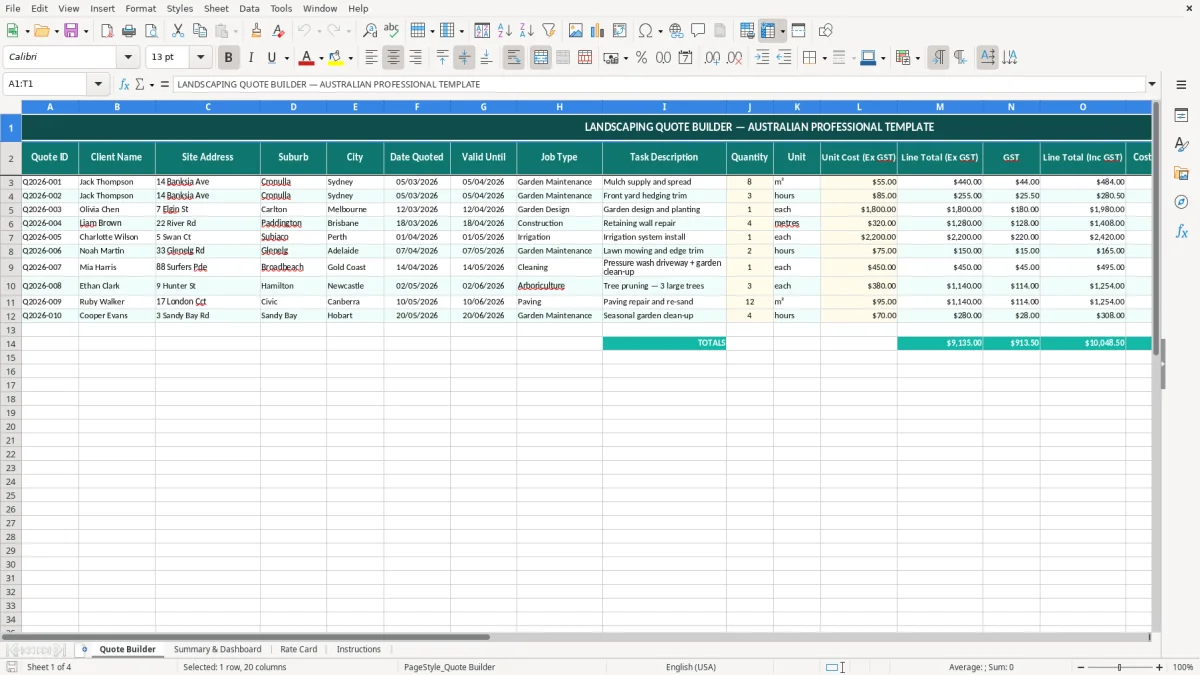
This landscaping quote Excel template helps you price jobs, add GST, and track gross profit in one workbook. It includes a quote builder, summary dashboard, rate card, and instructions sheet so you can put a clean quote together fast.
Use it for garden maintenance, mulch supply, turf installs, paving, hedges, or one-off clean-ups. The sheet layout is set up for Australian quoting, with amounts shown ex GST and inc GST.
If you are a sole trader, a small landscaping business, or an office manager quoting for a crew, it gives you a simple way to keep pricing consistent and see which jobs are worth taking.
This workbook suits the people who quote garden and outdoor work week in, week out: sole traders, small Pty Ltd landscaping crews, office managers at trade businesses, and bookkeepers checking pricing before jobs go out. It is useful when you are quoting a mulch top-up on Friday afternoon, a turf install on Monday, or a larger strata maintenance job before the next pay run.
The Quote Builder sheet gives you 20 fields across one line-item table, including quote ID, client name, site address, suburb, city, dates, job type, task description, quantity, unit, unit cost ex GST, line total ex GST, GST, line total inc GST, cost to deliver, gross profit, gross margin %, status, and notes. That makes it handy for a crew doing 6 quotes a week, or a landscaper handling 30 small residential enquiries a month.
If you are quoting 8 jobs this week and 3 are waiting on the client to reply, the status column helps you sort the pile fast. A small business with 2 crews and 1 office admin can see at a glance which quotes are live, which are stale, and which need a follow-up call.
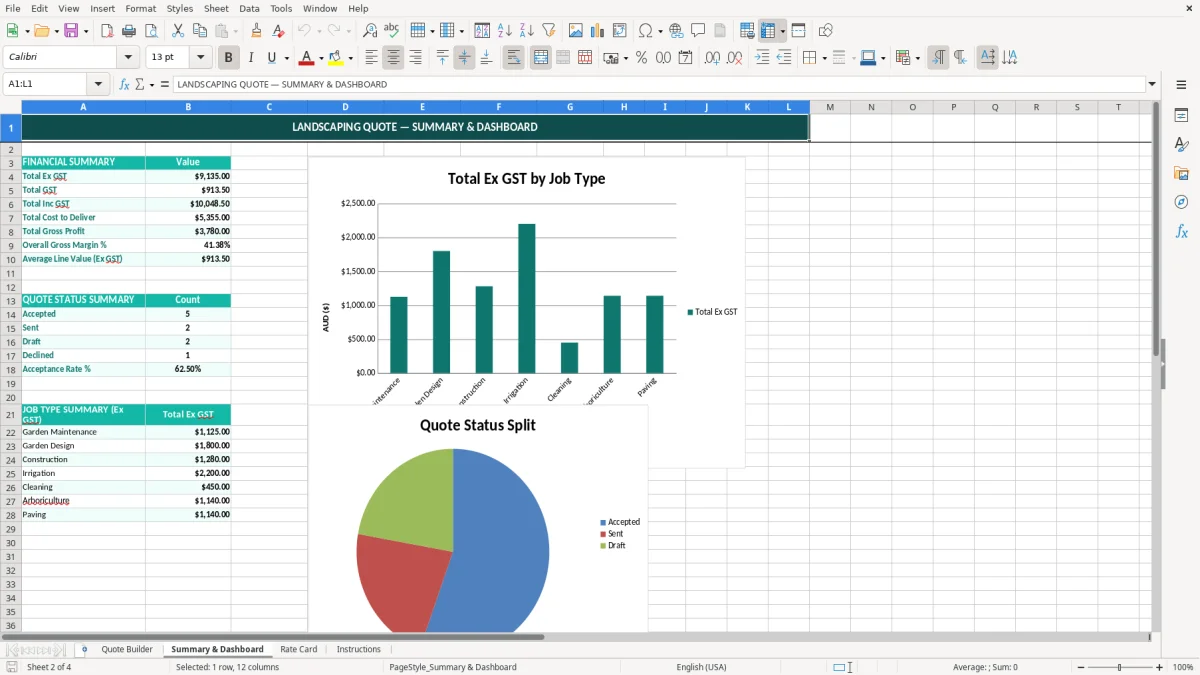
The Summary & Dashboard sheet is for quick checking, not deep accounting. Use it to see volume and direction, then compare it with your profit and loss later if you want to see whether your quote rates are actually holding up.
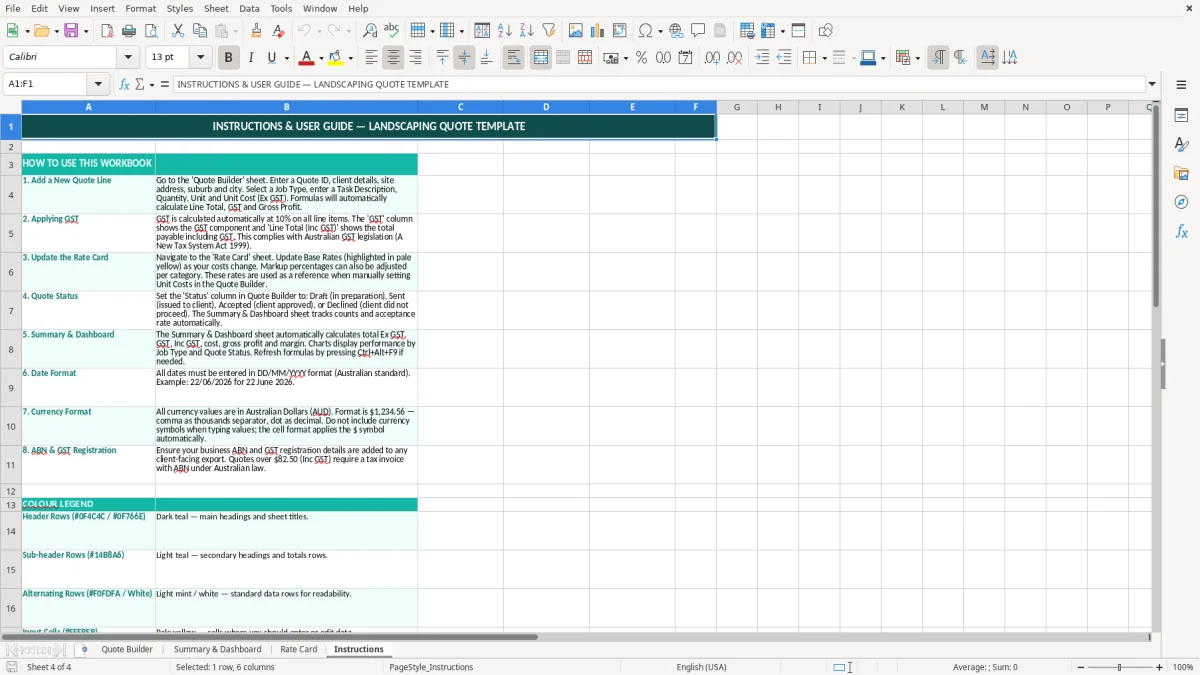
In Australia, landscaping quotes usually need to show pricing clearly because many jobs turn into tax invoices once the work is accepted and supplied. If your turnover reaches $75,000 a year, you need to register for GST with the ATO, and for not-for-profits the registration threshold is $150,000. Once registered, you charge GST at 10% on taxable supplies.
A tax invoice over $82.50 must show the supplier identity, ABN, date, what was supplied, and the GST amount separately. This template already separates ex GST and inc GST amounts, so if you quote a $1,800 paving job plus $600 of materials, you can show $2,400 ex GST and $2,640 inc GST without fiddling with manual add-ons.
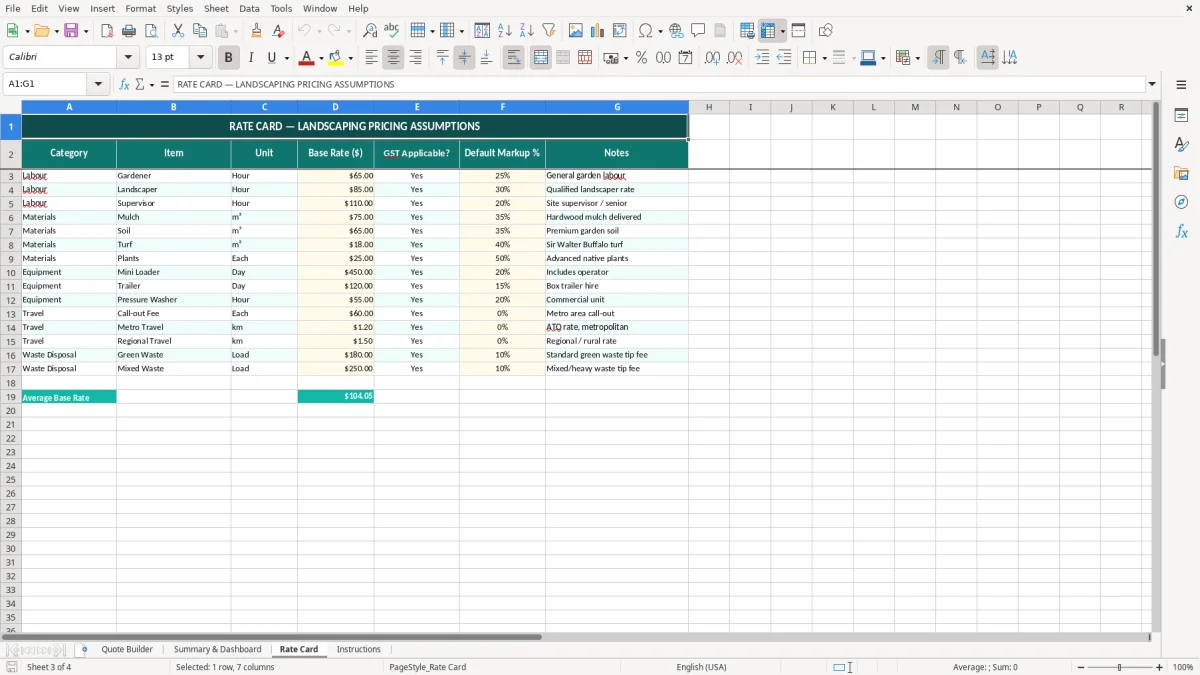
Most tradies quote on 14 or 30 day validity periods because material prices move and labour is not getting cheaper. If a quote for 12 hours of labour at $95 an hour sits open for 6 weeks, that is $114 of labour cost before you have even touched fuel or disposal. Locking in a valid-until date helps you avoid eating the rise later.
The ATO expects you to keep business records for 5 years. Keeping quotes, accepted jobs, and the final invoice together makes it easier to back up GST claims, check margins, and answer questions if a client disputes what was included in the price.
Keeping the quote with the accepted job and final invoice makes the paperwork complete, and a job quoting sheet gives you one place to store the original price, revisions, and sign-off.
The most common failure is underquoting labour and delivery. If you price 6 hours of site work at $85 an hour but the job actually takes 9 hours once you add load-out, travel, and cleanup, you have given away $255 of labour before GST and before fuel.
Another trap is forgetting the delivery cost or waste disposal cost. A mulch job that looks fine at $720 ex GST can turn ugly if you miss a $140 tip fee and a $60 fuel run, because your gross profit can collapse from a healthy $240 to almost nothing.
The gross margin % field matters because small jobs can hide small mistakes. On a $1,250 quote, being wrong by $100 cuts your margin by 8 percentage points, which is enough to wipe out the profit on one job when you are paying wages, super, and transport.
If you do 20 quotes a month and only follow up half of them, you are leaving work on the table. A single missed accepted job at $4,000 inc GST can be the difference between covering a fortnight of wages and having to dip into cash flow reserves to make the next BAS payment.
The easiest way to keep this workbook alive is to tie it to a routine you already do. Most small landscapers update quotes when they finish the Friday clean-up, or when they review the next week’s jobs before the crew starts on Monday.
If you are up to 50 to 100 quotes a month, or you need live job costing, progress billing, and team scheduling, you will probably outgrow a spreadsheet and move into software such as Xero or MYOB. Until then, this template gives you a clean middle ground: quick to use, easy to follow, and strong enough to price real landscaping work properly.